Use case · Continuous threat modeling

Continuous threat modeling that stays current as your system changes.

Continuous threat modeling keeps the threat model current as the system evolves, instead of producing it once at design time. Reykur runs that loop from the user story to the merged pull request, and verifies that every control was actually built.

See the loop
Triggered from Jira & LinearVerified at every PRLiving, connected models
Where it breaks today

A point-in-time threat model is wrong by the next sprint.

The fix is a loop
01

Stale model

The diagram is accurate the day it is drawn. Updating means starting over, so teams don't, and the model drifts further from the running system with every deploy.

02

No verification

Most tools stop at enumerating threats. Nobody confirms the recommended control was actually built, so “we did a threat model” says little about real risk.

03

Findings arrive late

Security shows up after the code is written, in a separate tool, owned by someone else. That means rework, rollbacks and broken developer flow.

04

It cannot scale

A handful of security people support hundreds of engineers shipping every day. They cannot re-model every service and every change by hand.

The solution

One continuous loop that closes the gap.

Follow a single feature around the loop: ingested from the story, modeled, embedded in the ticket, built, and verified at the PR.

01Ingest

A user story lands in your tracker

The moment a story is created in Jira or Linear, Reykur picks it up. Nobody has to remember to start a threat model.

  • Every story, not just the ones someone flags
  • No review to request from security, no queue to wait in
New issue
LinearJiraConnected
New story · ENG-2481
Add OAuth / SSO login

As a user, I want to sign in with my existing Google or Okta account, so I never have to manage another password.

JDStoryIdentitySprint 24
Reykur is modeling this story
02Design

Model the design on a live canvas

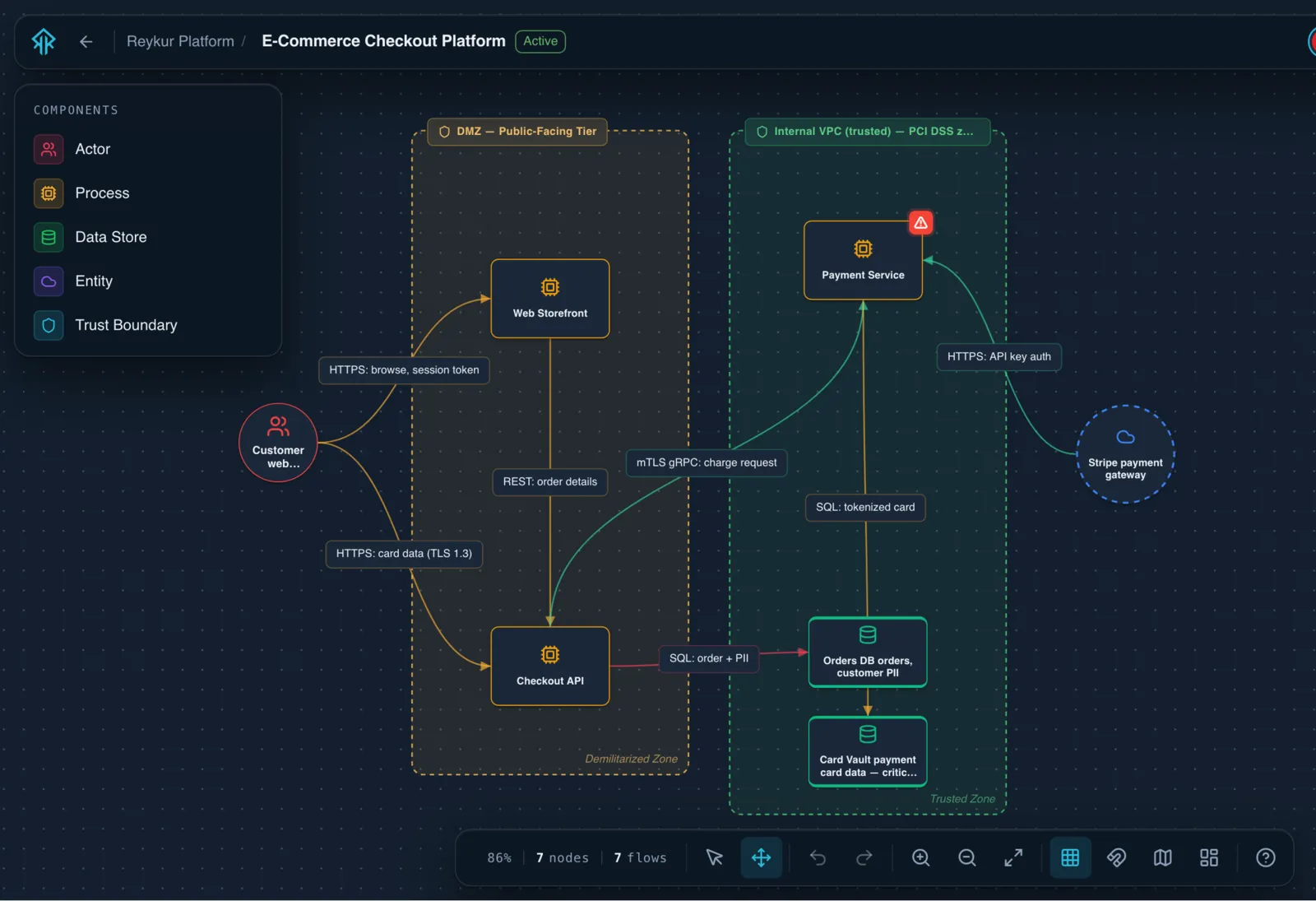
Components, data flows, trust boundaries and data assets are mapped on a real-time, collaborative canvas, and kept live instead of redrawn for the annual review.

  • Components, data flows, trust boundaries, data assets
  • Real-time and collaborative, the whole team on one canvas
reykur.io · canvas
Reykur canvas mapping a checkout platform’s components, data flows and trust boundaries.
03Embed

Threats and controls land in the ticket

Reykur writes the threats, recommended controls and security requirements straight into the issue developers already work in.

  • Threats, controls and requirements inside the issue
  • Written the way your team writes tickets
Jira · ENG-2481
Payments / ENG-2481
Add OAuth / SSO loginIn progress
Security modelgenerated by ReykurAI
ThreatOAuth token theft via open redirectHigh
ControlPKCE + short‑lived access tokensRecommended
RequirementRotate refresh tokens on every use
3 items written by Reykur · synced just now
04Build

Engineers build it in flow

Security is specified before code is written, so developers build the controls in as part of the story, without needing to be security experts.

  • Controls implemented as part of the story
  • Nothing to retrofit at the end of the cycle
oauth.ts · feat/oauth-pkce
oauth.tsroutes.ts
10import { createPkce } from './pkce'
11export function startLogin(req) {
+ const pkce = createPkce()
+ token.ttl = '10m'
14 return redirect(authUrl(pkce))
15}
feat/oauth‑pkceLn 13, Col 18 control: PKCE
05Verify

The PR is graded against the controls

At the pull request, Reykur verifies the recommended control was actually implemented. It is the question every threat modeling framework ends on, and the one almost nobody answers: did we do a good job?

  • PR-time check that the control shipped
  • Catches security regressions before they merge
GitHub · pull request #418
OpenAdd OAuth / SSO login#418
Build / compilePassed
CI / unit testsPassed
Reykur / control verificationPKCE implemented · 1 control verifiedRequired
All checks have passedMerge pull request
Runs inside the tools you already use
JiraLinearGitHubGitLab
The differentiator

Knowing a control was recommended is not knowing it was built.

Inside the continuous loop, PR-time verification closes a gap no review can close on its own: one traceable line from threat to verified implementation. Bring a manual deep dive to your most critical components and Reykur proves those controls shipped too.

Threatin the model
Controlin the ticket
Verifiedat the PR
Why continuous

Point-in-time, automated or continuous threat modeling

Automated threat modeling generates a model from what already exists. Continuous threat modeling keeps that model current from the first user story and verifies the controls it calls for.

Point-in-time review
  • Out of date before it ships
  • Controls recommended, never verified
  • Findings arrive after the code is written
  • One review a year, at best
Automated generation only
  • Regenerated from code, after the design is set
  • Threats listed, controls not tracked
  • Findings land in a separate tool
  • Covers what the scanner can see
Continuous, with Reykur
  • Updated on every story, automatically
  • Every control verified at the PR
  • Security specified before code is written
  • Every change, every service, every day
Evidence for the frameworks you report against
SOC 2ISO 27001PCI DSSDORA
Who it’s for

One loop, four payoffs

The same mechanism pays off differently for every role: guidance for devs, coverage for AppSec, assurance for leadership, predictability for product.

Developers & engineers

Security guidance in your flow, not a pen-test surprise.

  • Threats, controls and requirements are already in the ticket you’re working on.
  • Security is specified before code and checked at the PR, so there’s far less rework.
AppSec & security architects

Coverage at scale, and proof your guidance landed.

  • The loop does the routine modeling, so the team isn’t the bottleneck for every change.
  • PR-time verification means you know a control was actually implemented.
CISOs & security leadership

Provable security across the whole portfolio.

  • Live visibility across every project: what’s modeled, which controls are verified, where risk was accepted.
  • Continuous, defensible assurance for the board and auditors, not point-in-time heroics.
Product owners & EMs

Security in the definition of done from day zero.

  • Security requirements are scoped into stories automatically, part of done from the start.
  • Fewer late surprises and schedule shocks, so delivery is more predictable and faster.
Questions

Common questions about continuous threat modeling

Where does the term come from?

From Autodesk's Continuous Threat Modeling methodology, written by Izar Tarandach and published as an open handbook. It was designed so that development teams could threat model their own work inside agile sprints, with less dependence on security specialists.

How is continuous different from automated threat modeling?

Automated threat modeling is the tooling: generating a model from code and infrastructure, proposing threats and controls, and checking pull requests against them. Continuous threat modeling is the practice of keeping that model current from the first user story onwards. Reykur does both. The model updates automatically on every story, and each control is verified at the pull request.

What triggers a threat model update?

A new user story in Jira or Linear, a change to the design on the canvas, a plan from a coding agent, or a pull request. Each event updates the parts of the model it touches. Nothing is redrawn from scratch.

What is verified at the pull request?

The controls that were written into the ticket. Reykur reads the change, checks each control against it and reports which are met, partly met or missing. The result can gate the merge or simply inform the reviewer.

Does this replace an expert-led design review?

No. High-risk components still deserve a deliberate review. Reykur runs those on a live canvas as a traditional threat modeling session, and the continuous loop keeps the resulting model current afterwards.

How is this different from a code scanner?

Scanners look for known bug patterns in code that already exists. Continuous threat modeling works at the design level, before code is written, and catches flaws a scanner cannot see, such as a missing authorization check between two services or an unencrypted data flow.

How does it fit into Jira and Linear?

Reykur listens for new stories, writes the threats and controls back into the ticket, and updates the ticket when the pull request is verified. Engineers keep working in the tracker and the repository they already use.

What evidence does it produce for SOC 2 or ISO 27001?

A traceable record for each change: the threat, the control it called for, the ticket the control was written into and the pull request where it was verified. That record is the evidence for secure design and change management controls in SOC 2, ISO 27001, PCI DSS and DORA.

Updated 6 October 2026

Threat modeling that finally keeps up with how you ship.

Watch the loop close end to end in a 20 minute walkthrough: design, ticket and PR.

Get early access

Explore the other use cases

Secure vibe coding

Agent plans reviewed against your threat model, before any code is written.

Explore

Get early access

Be among the first to try Reykur and help shape continuous product security.

No spam. We'll only email you about Reykur.